A Lyrical RENalysis by D.B. Myrrha B.A., M.A.T, O.G., A.B.C., O.P.P.*
*Not a doctor
Introduction:
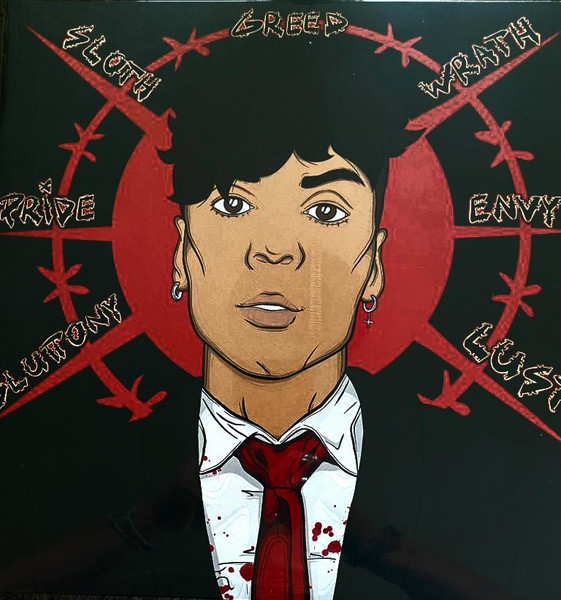
“Seven Sins” is the first track on Ren’s 2023 album Sick Boi. The last track completed for the album (most of the songs were written between 2020-2022), it was originally meant to be a short introductory piece, a eulogy written by the artist for himself. Instead, it evolved into a true masterpiece, introducing the various recurring themes of the album through a powerful dive into the experiences that inspired and drove the creation of Sick Boi.
Ren has claimed that “Seven Sins” is one of his favorite tracks on the record, and I can see why. Anyone who has listened to the entirety of Ren’s catalog, from the ‘Trick the Fox” days through Freckled Angels, the Demos, the Tales, and the Big Push originals (see their album Can Do, Will Do) will recognize this song as some of Ren’s most intense and sophisticated writing. He just seems to get better and better the more he taps into his creativity (and, at least here, into his pain.)
This song, while not his longest, is one of the most densely packed with meaning on the record, as it introduces the themes found throughout Sick Boi, both lyrical and musical.
Musically, “Seven Sins” introduces many of the vocal and instrumental styles that are utilized throughout the record. Featuring layered choral music, strings, singing and rap, verbal punctuation with the use of trap style interjections and growls (e.g. grrr, chee!) and driving beats (basically returning to Ren’s roots in drum and bass and UK drill), “Seven Sins’ plays the role of overture.
Many have looked at specific songs on the album and pronounced them works of theatre (looking at you, “Money Game 3”), but the album, in truth, can be seen as a theatrical piece in its entirety, with arcs of both character and action. Intense and emotional, Sick Boi takes us beyond many modern rap albums and into old-school storytelling. We can’t forget that, first and foremost, Ren is a modern bard.
Sick Boi’s main theme is illness, which may seem obvious from the title, but it’s not that simple. Ren not only contemplates illness of the body and mind, but of the spirit and society as well. None of these themes are new to his body of work. Writing music throughout his decade-long struggle with misdiagnosed Lyme Disease and the complex aftermath was his self-described savior. “Music,” he has said, “is the closest thing to God I know.”
Science has shown that the creation and appreciation of music as therapy can actually ease physical pain for some people. At his lowest point, bedridden and severely underweight, even music was out of his reach.
Despite being an agnostic, Ren has always been a seeker of truth and has reached out to God in many of his songs. Illness of body and mind led to a crisis of faith (Ren was first misdiagnosed bi-polar and went through a three-month period of psychosis where he feared he was either the subject of an experiment or possessed by Satan), another theme threading its way through much of his music. Not finding assurance of the existence of God seems to have been a cause of deep grief for Ren, who longed for solace in his darkest days. Still, he is a believer. “I believe in people”, he says, and his actions seem to confirm that is true.
From the beginning, well before the onset of his medical problems, Ren was always a champion of unity, peace, and equity. Dark and light exist in all of us, and it is up to us to find balance in all things and do our best to ease the suffering of others. It is up to us to challenge institutions that cause suffering to large numbers of people, especially the creation of financial inequality based on greed. Ren’s stance isn’t so much political as humanistic; he recognizes the need for capitalism and that we are all both victims and perpetrators in the violence of the system. However hypocritical it might be, he continues to speak out against the hoarding of wealth and the constant desire for more gain. As someone who has literally said, “Fuck the money and fame,” it will be interesting to see where he goes as both come into his life. I tend to believe he is the type of person who will always think of others and use his position and resources to promote a better society.
Lyrics
Intro
Part A, the Eulogy
Salwch yw fy athrawen
Fe dorrodd fy ngwên
Mae fy esgyrn teimlo’n hen
Yma yw gorwedd corff Ren
(Pain is my teacher
It broke my smile
My bones feel old
Here lies the body of Ren)
This here, I believe, was the original entirety of “Seven Sins”. Sung in his native Welsh, the intro utilizes influences from Welsh folk music, which includes choral singing.
It’s both beautiful and haunting. Ren acknowledges that pain has been (perhaps his greatest) teacher, as our suffering tends to teach us about ourselves, what we can withstand, what we can do and can’t do, how to be patient, how to adjust and survive. Difficult lessons, unwelcome and unwanted, but profound, nonetheless.
In his 2016 song “Hold On”, Ren sings about being twenty-five with a body that feels like it’s 150. His chronic pain makes his bones ache (he mentioned that he often feels pain in his legs and feet in more than one recent interview.) The pain of chronic illness never fully subsides, and at the peak of his illness, it must have felt unbearable at times. He admits he spent hours crying until he couldn’t cry any more. His smile was broken, and how can we blame him?
“Here lies the body of Ren”, a common epitaph, a fitting end for a eulogy, a cry for the cease of suffering, but a literal comment on the years spent in bed, which he elaborates on in further verses.
Although I don’t speak Welsh, the stanza obviously utilizes end rhyme: athrawen/ngwên/hen/Ren. It’s fascinating to hear the language, this nod to Ren’s native culture.
Part B
I lay broken on the kitchen floor
I clawed at the laminate
Pain wandered my body – an uninvited guest
Bones were a home where the devil could rest
I cursed the gods, cursed my messiah, cursed my maker
I cursed all of creation
There I lay, feeble and thin
Sick boi, sick boi, seven my sins
This verse comes from an actual event in Ren’s life. In 2015, after raising £6,000 for a fecal transplant (touted as a miracle cure for intestinal dis-ease), he had an intense auto-immune reaction which bound him, once again, to his bed. After lying in bed for days, thirst motivated him to get a drink of water. Once in the kitchen, the pain took over, and he found himself on the floor. He said that this was the beginning of his struggle with psychosis, as reflected in the line “bones of a home where the devil could rest.”
Ren’s food sensitivities caused by autoimmunity prevented him from eating nearly anything at the time, and he subsisted mainly on chicken and lettuce. This caused him to become “feeble and thin” bottoming out at 112 pounds on his 6’1” frame.
Why, might we ask, does he connect this illness with his own sin? Did he consider the sickness a punishment? In the midst of his psychosis, he felt helpless, no longer in charge of his own body or mind, and therefore vulnerable to sin, the Devil more present in his life than God. This would not be completely out of character for the chronically/mentally ill. There’s no doubt that living in such pain would lead to longing for what others have (envy) at the very least, if not all potential expressions of sin. He connects to all seven, and it’s for us, through the scope of his music, to discover how and why. Perhaps the first sin is the questioning of God, a trait shared with the fallen angel, Lucifer.
In this stanza, Ren leans into a spoken word style, rhyming in a way that is deliberate, but feels incidental. Rhyming the third and fourth lines (guest/ rest) and the seventh and eighth (thin/sins) maintains the poetic form within a more casual scheme.
Musically, in the eulogy, he invites us into the song with a series of stacked vocals, creating a haunting choral effect. He then drops into the rest of the intro with an intense melody, punctuated by a drill-influenced drumbeat and what Knox Hill refers to as “sad violin.”
Verse 1
Have you ever felt pain?
Stomach wrenching, unrelenting, tell me…
Have you ever felt pain?
Condescending, muscles clenching, tell me…
Have you ever felt pain?
A rose emerges from the pavement cracks
They’ll write my eulogy with broken glass
Eternal parallax, pain
Most people have endured one sort of pain or another, physical, emotional, or psychological, but few (although it seems to be a growing number) of us experience the continuous, life altering pain of invisible and/or chronic illness. Many of us will never struggle with this, and we can be grateful for it. Part of Ren’s goal with his music is to give “a voice to the voiceless” and encourage those of us fortunate enough to have manageable conditions (or none at all, if we’re lucky) to have greater empathy for those who suffer.
Although I myself have suffered bouts of intense pain from acute medical conditions and mental illness, I know that many people I care for endure much worse. As people age, and as new illnesses emerge which ravage the immune system, the chances that we remain perfectly healthy diminish; most of us are only “temporarily abled”. For those like Ren, who suffer from Lyme (or MS, ME/CFS, EDS, POTS, treatment resistant depression, schizophrenia, Bipolar, or any other long-term affliction) life is nearly always painful to some extent. Any reprieve, most likely, is temporary.
For those who don’t struggle with these conditions, it’s difficult to imagine what it’s like, but it’s important to try to understand and show compassion and empathy (rather than pity) to those who do. Ren’s music gives us a window through which we can glimpse a terrifying reality, but a reality for many all the same.
It’s interesting how Ren refers to pain as “condescending”, a personification that implies that the pain feels superior to the body and mind. It’s an external being, a force (of evil?) that acts from without rather than within. It reflects an external locus of control, wherein the self has been rendered powerless to the actions of others, in this case Pain.
In the last lines of this verse, a rose emerges from the cracks in the pavement. Beauty emerging from brokenness. Roses themselves can be bringers of pain by their thorns, which can cause one to bleed. However, their beauty is prized and cannot be denied. Ren knows that his soul holds beauty (he sings about this in “Run Away” [2016]) despite his own despair. Once again, the theme of dark/light, the balance of all things, appears in his poetry.
He writes his eulogy with broken glass. In my mind’s eye, his eulogy is carved into his body, a release of emotional pain through physical pain, as reflected in the songs “Suicide” and “Masochist.” This was not, perhaps, the original meaning, but writing with broken glass implies the pain of shards in the hands, if nowhere else.
A parallax refers to the apparent shifting of objects (usually in the sky) when observed from different perspectives. So, although the pain is always present, it may look different from shifting points of view. From the outside, others may not be able to understand because they have a faulty perspective. This might refer to people’s attitudes in general or specifically to the medical professionals’ inability to properly see and diagnose the problem, shifting from one faulty opinion to another. Ren obviously felt that this pain would be crippling forever (see “Insomnia”, in which his sleepless mind tells him “You’re always going to suffer, Ren.”) and that the perspectives on the cause of his agony would never align.
In the second half of the verse, Ren uses a new poetic form to create a punctuated flow. The repetition of the words “pain” and “tell me”, elicit a response in the mind of the reader. Have we ever felt pain? For those who struggle chronically, it’s a call of recognition, a connection to the artist. For those to whom pain’s a stranger, it’s a call for empathy.
Four internally near-rhyming words in the first stanza (wrenching/unrelenting/condescending/clenching) and the internal rhyme (parallax) in the last line, which echoes the end rhymes of lines six and seven, punch up the stanza with descriptive words evoking dark imagery and an almost visceral reaction. The rhythm is enhanced by the presence of the four quadruples made from those same words: stomach wrenching/unrelenting/condescending/muscles clenching. An example of Ren’s layered wordplay and exquisite use of multi-syllabics.
Verse 2
Pain – the author, I accept this
Pain the teacher, bruised apprentice
Pain resisting, pain will come
Pain the mother, I’m the son
Pain that splits you in two when it hits you
The dark and the light are converged to one
Pain that twists you, the Heavens dismiss you
The Father, the Ghost, and the Holy Son
The second verse describes the personal relationship Ren built with his personified Pain. In the intro, Ren refers to Pain as an “uninvited guest”, but in time it becomes an inherent part of his life. The author, who writes his daily story; the teacher he mentions in his eulogy; the pain that uses him up, betrays him, and spits him out no matter how hard he resists; and the mother, on whom he is dependent and who births him, guiding his growth and development.
There are few things less empowering than being the protagonist in a story that someone else is writing. To have no control over our actions, our feelings, our responses, or even our movements, can make one feel hopeless and impotent. In “Hold On,” Ren asks: “Am I the protagonist in this tragedy or will I be the author of stories unmade?”
In the context of “Seven Sins”, however, it is made clear that at some point Ren did not feel at all like the author of his own story. Later he will claim the title again, but this song dives deep into the origins of this album, the pain, both physical and mental, that controlled the narrative.
Anyone who knows Ren’s catalogue or has heard him speak of his illness knows that he considers his illness both a curse and a blessing, and that the blessing is expressed through the lessons he learned from the experience and the music he made to honor them. The lessons, as mentioned above, of patience, of endurance, of resilience, and of the delicate dance between dark and light within (as explored in “Hi, Ren,” and which he will again reference below) have made him who he is, and he must show acknowledgement to Pain for those valuable gifts.
The lyrics in this verse continue to pack a punch. Pain. Pain. Pain. Pain is personified as author, teacher, an unstoppable force, as mother. Each of these roles infer that pain holds a position of authority over the person, who then, helpless in its grip, suffers from an external locus of control. Ren is incapable at this point to exert power over his own life. Therefore, the end near-rhymes are reflective of his response (accept this/apprentice, come/son.)
In the second half of the verse, Pain is evoked at the beginning of the first and third lines as the scheme changes to a/b/a/b end rhyme (you/one/you/son) with a reflected you in the center of the first and third lines.
While the first half of the verse forms a rhythmic call and response, the second rises and falls in a lyrical wave.
Musically, this portion is more melodic, the lyrics more sung than rapped. The strings guide us through the pain.
Verse 3
Bar 1
Body bags, body bags, body-bagging me
Zip it up quick, a living zombie
I search for peace in the belly of a beast
Sick boi, sick boi, onomatopoeia
Body bags are a common image on Sick Boi. They appear in four songs: “Seven Sins”, “Genesis”, “Masochist”, and “Wicked Ways”. Of course, body bags are the objects of containment used to transfer corpses to the morgue. As a person who was on the verge of death and believed he would not live until 30, Ren seems to call to his final days, where he will be zipped into the body bag and removed from the pain.
At the moment, though, he is a “living zombie,” not living, but not dead either. He reflects on this again later, with the idea of being “buried while you breathe.” Maybe it’s just better to be declared dead, to try to make peace with it, than to continue the struggle. Zip up the bag and be done with it.
Though living in the “belly of the beast” (A reference back to the devil, resting in his bones), Ren still searches for peace, for respite if not a cure, before he will give in to the final rest of death.
Onomatopoeia is a word that is formed from the sound of the item it describes. In questioning how “sick boi” can be onomatopoeia, one might consider how the harsh syncopation at the end of the word “sick” might reflect the stabbing pain in his body, mentioned in the verses above.
Ren’s use of irregular rhyme and rhythmic patterns is part of what makes “Seven Sins” so aurally compelling. In the first line of verse 3, he repeats the term “body bag” three times. Twice as a noun and once as a verb, ending the line with the object of the coroner’s receipt: me. The second line contains the internal rhyme zip/quick, while the end rhyme matches the previous (be). A traditional a/b rhyme provides a slight change in the third line (peace/beast) while the last line is somewhat irregular. The repetition of “sick boi” with an alliterative b rhyme (onomatopoeia) where the poei is finished off with a final –a.
The cadence in this verse becomes more aggressive as it progresses. Ren, in his inimitable style, is starting to switch up his flows and intonation.
Bar 2
Running up a fever, followin’ the leader
Wanna be me, ha? Grass isn’t greener
Bright light seizure, dynamite dealer (Hya)
Dine at the table of the coroner, eat up, fuck
Fever is a symptom of illness, of course, and might also refer to the feverish or intensive manner in which Ren searched for his own cure. In his sickest days, failed treatment after failed treatment, even while suffering from psychosis, Ren searched desperately for answers. He scanned the internet. He tried alternative medicines, and he sought spiritual guidance and healing, visiting shamans and searching for freedom from his (what he felt were literal) demons. In this he sought out spiritual leaders, none of which solved his problem (and no doubt deepened the rift between him and God.)
Even though no one would envy him then, as he came out of his illness in 2017, he was able to perform and gain recognition (wherein some people would likely begin to see his position as enviable.) Even after his successful stem-cell transplant, he still felt anguish (he talks about this in his remix of Venbee’s “Dead in the Gutter”) and continues to struggle with pain to this day. Even though he is seeing success and recognition now, his physical and mental health are still a challenge, a reminder to those on the outside that the “grass isn’t greener” and things aren’t necessarily perfect. There is no real reason, then, to envy the life Ren leads.
No one knows if or when things might get better, but of course, things could always be worse. Ren knows that life can be unpredictable, how small things can set off big reactions, and at any time, one can find themselves on the brink of death.
Fuck.
He invites us explicitly to join him at the table of death, the coroner’s table, the slab, the bed in which he lay between life and death for a large part of the last thirteen years. Just his luck. He invites you to join him, if you really want to live his life. Go on, eat up. (Envy, greed, gluttony…want more?)
The first three lines hold an interesting syncopation. The first line has a double internal/external alliterative pattern: running/fever, following/ leader. The second shows an irregular near internal with “me, ha?” With a rough matching of the ee/ah sound to the ee/-er seen above and again at the end of the line (greener.) The –er is then repeated in the internal/external of the third line (seiz–ure/ feeler) Also within the line is the internal match of light and dynamite.
The last line diverges from the previous three. The only –er word, coroner, appears in an irregular position, followed by “eat up.” The uh in up is then echoed by the uh in the transitional word fuck.
Bar 3
Thirteen years and I’ve been feelin’ so stuck
Lucky number thirteen, just my luck (Shi)
Empires tumble, rubble and dust
The universe shrinks and the planets combust (Bla)
Ren fell sick at age 20 and is 33 today. For thirteen years he has wrestled with Lyme disease and its aftermath. Today, the Lyme is out of his system, but he is left with an ongoing struggle with autoimmune effects such as brain fog, pain in his extremities, and Mast-Cell Activation Syndrome (MCAS) which causes allergic reactions to most foods. Perhaps this is another source of the reference in the last stanza to eating at the table of the coroner. it’s “just his luck” that after thirteen years he is still struggling. Still, it is due to some luck that his health has improved. A doctor in Brussels informed him he had Lyme. Another doctor in the United States offered him the stem cell transplant, which worked to turn things around for him (although it was a chance, as it has the opposite effect on others.) In addition to his hard work, it was with some luck that “Hi, Ren” (a video that was almost curtailed before it was made, and was made, at last, in a rush) went viral.
It was seemingly in defiance that Ren rereleased Sick Boi on Friday, October 13, 2023, after which (with a lot of effort and a little luck) it went to #1 on the U.K. charts (Of course, he couldn’t know that it would at the time of writing.) Perhaps thirteen isn’t such an unlucky number, after all.
However, in the moment, thirteen can feel like misfortune. He lost so much. His twenties went by in a haze. What he thought was his one chance to be a star collapsed into rubble. His world shrunk and seemed to implode, leaving him in the dust.
The rhythmic flow of “Seven Sins” is seriously interesting, with the irregular placement of words carrying the lyrics forward in consistent motion, in the third stanza, the lucky number 13 is transposed from the beginning of the first line into the middle of the second, while the words lucky/luck appear at both the beginning and end of the second line. It’s placement at the end rhymes with the ending word “stuck” which appeared in the first line, the third and fourth lines have the standard end rhyme, with dust rhyming with combust. The /u/ sound is repeated throughout the third line, adding the internal rhyme of tumble and rubbles.
This verse also utilizes the vocal ad libs Ren peppers his songs with, accentuating the lines with added vocal emphasis.
Bar 4
In God we trust
God tied a noose to his neck and he walked to the edge and he jumped
Angels wept
And I beared witness watching the whole thing unfold from my bed
People are often told to trust in God’s mercy and compassion, but in Ren’s case, he felt abandoned, a theme that is woven through many of the tracks on the album, and many of his songs previous. With the devastating loss of faith (or the inability to fully grasp it in the first place,) God might seem non-existent, or if he ever did exist, dead. It is a powerful image here, of God committing suicide. Could this be because he lost faith in humans, or in himself? Can God feel so powerless that he could negate his own existence? Regardless, Ren felt abandoned, empty, which is something those left behind might feel when one they depend on takes their life (and as most know, this survivor’s despair in not unknown to Ren.)
Left behind, the angels are left weeping, and Ren, helpless, can only watch as he is abandoned by the one being who might be able to save him.
The juxtaposition of short and long lines depends on the internal alliteration of repeating vowels to carry it. Trust shares a short /u/ (uh) with jumped, while line 2 also includes internally matched vowel short /e/ (eh) in neck and edge. This eh is repeated in the final rhymes of lines 3 and 4 (wept/ bed.)
Bar 5
A bed where I never deep rest, a bed where I’m always depressed
A bed with a human oppressed
A bed for the tomb where I slept
A bed in this room that’s a womb for this mess
2015 was the lowest point of Ren’s illness, and as we discuss above, he was bedridden for about 23 hours a day, occasionally getting out of bed to shower in excruciating pain. He also managed (since he couldn’t make music) to do short blogs/vlogs on his health. These videos are heartbreaking. Ren has said he only keeps them up to encourage others who are going through the same pain.
The bed, then, was Ren’s whole world at the time. Anyone who has experienced an extensive period of pain will know that healing rest in the midst of excruciating pain is evasive if not impossible. Being bedridden, unable to do anything (even read in Ren’s case), is agonizing. Depression follows the feeling of loss and oppressive boredom and lethargy. The bed as tomb is self-explanatory. The image of the womb, where pain simply encloses and engenders more pain is a potent one. Lying still in pain causes increased stiffness. It can cause chafing, rashes, blisters, cramping, all these on top of what is already existent. Both womb and tomb, the bedroom provides both comfort and torment.
As in verse two, repetition takes a major role. Following on the heels of the last stanza, the words “a bed” are repeated five times. Since the first line is basically two combined, there is again a double internal. A bed (at the beginning and then repeated at the beginning of the second part) and deep rest rhymed with the homonym depressed.
The other three lines also begin with “A bed…” and end with the /eh/ sound, although line four has a near rhyme (slept) which diverges from the other end rhymes which rhyme with depressed and utilize the /ess/ sound (oppressed/ mess.) There is a repeated internal series of rhymes within lines 2-4: hum–an/tomb/room.
Bar 6
Sick boi, bitten by a tick boy, tell me how it feels to be buried while you breathe (Bla)
Stones and sticks, boy, pain is a gift, boy, hard to make a stand when you crawl on your knees and I kneel
For the first time, Ren directly refers to the nature of his affliction. Bitten by a tick, he has been infected by Lyme. A tiny catalyst to a potential lifetime of pain.
There is no doubt that being cut off from life while one remains breathing is like being buried alive. Barely able to manage even basic tasks, cut off from the things that bring you solace and joy, unable to eat enough to sustain yourself; a shell of the person you were,
Stones and sticks are instruments of harm (“Sticks and stones can break my bones…”) and his illness has beaten him and left him bloody, bruised, and nearly lifeless. Here is one of the first indications that his illness will be personified as a malicious character in his story. A demon, a cannibal king, a murderer. It’s just like a torturer to sadistically insist that the pain inflicted upon the victim is a gift.
Ren, in his relentless optimism, took on the point of view that somehow his pain will prove to be a lesson, that his mental struggles are a gift that would bring him deeper insight, understanding, and empathy. We see this in many of his early songs. Even through the darkness, Ren always sought the light. It’s hard, however, to keep hope as you crawl through the tunnel. How can you be strong and persist (take a stand) when your knees are scraping on the rocks until they bleed?
All he can do is kneel in supplication, but to whom? A God who has abandoned humanity? To Hope? To whom?
Foreshadowing the following song, the thematic lyrics have a percussive sound (Ren compared rapping to a drum kit in his interview with Elizabeth, so it’s no surprise that his flows resemble different percussive patterns.) Sick boi/tick boi rise and fall, carried by the words bitten by, which connect the two aural one-two punches with an /i/ for assonance and the alliterative /b/ which adds impact. The alliteration continues on in buried and breathe. Sick and tick are reflected by sticks (boy) and gift (boy.) The /s/ in sick matches with the /s/ in stick, as well as the esses in stones and stand. A repeating ee sound, found in me/feels/breathe/knees/kneel ribbons through the stanza, and curls into the next line below. This song is one of the richest in phonetic wordplay that we have seen from Ren, and we haven’t hit the pinnacle yet.
Knox Hill points out that the steady, percussive pace of this section feels like a heartbeat, which, after the last sad string, falls silent.
Verse 4
I kneel at the altar of my own disease and I beg
In the absence of faith, disease is his messiah, as he will once again refer to in “Lost All Faith,” He can only appeal desperately to the illness for reprieve.
This line stands alone as a powerful transition. The imagery is intense, and the word “beg” stands out in isolation. How alone we feel when we have to beg.
The word “kneel,” repeated again from the previous line provides emphasis. Phonetically, the /ee/ sound is repeated inside the word disease, a simple assonance.
Bar 1
I begged the sky for mercy
Mercy never came, life did me dirty
Thirty-three and hurting, cursing
Jesus died at thirty-three and still, my sins are lurking
The penitent begs to the empty sky, to no avail. He is left a victim with no recourse, targeted for no reason, life sucks. It’s needlessly cruel. Even now, out of the worst, of it, the pain continues. The prayers never fully answered.
Thirty-three is often an age of contemplation for the spiritual person, as it was the age of Christ’s martyrdom. Jesus is believed to have died for our sins, but when it feels as if you are still being punished, it may be hard to believe that your sins have been lifted. If the sinner has been forgiven, why are they still in pain? Once again, the victim is blamed (albeit only by himself) for his own suffering.
Again, the last line of the previous stanza swerves into the beginning of the next. The rhyme scheme is pretty simple in this section: mercy/mercy/dirty/thirty and the assonant near rhymes hurting/cursing/lurking. All of these words contain /ir/, /er/, /ur/. The positioning of these rhymes is interesting, as some of the words appear at the beginning of the line, and others at the end, although not in a perfect pattern. the last line begins with Jesus, which doesn’t follow a pattern, but does have a phonetic connection with the “three” in thirty-three. Oh, and sky in the first line rhymes with died in the last. These types of “incidental” rhymes keep poetry interesting. They may not even be intentional, but that’s part of the beauty of it. Our minds are naturally musical /poetic lumps of meat that produce beautiful things. Thank you, brains.
Musically, this group of rhyme schemes lean into a condensed polyrhythmic form, which also serves to keep the listener’s interest as the beat moves in quick repetition, rather like a loop of sound, spinning us like…
Bar 2
Gears are turning, future stays uncertain
Surgeon incision, murder ambition
(Fear of the unknown preserves a religion
Denounced the gods when my body went missing)
Although time moves ahead, and (at least at 33) things are again moving forward, the future of Ren’s health remains uncertain. Will his latest treatment alleviate most or all of his lingering symptoms? Will he always need to seek new answers, and will he be able to find them?
“Surgeon incision, murder ambition” can have a few different meanings. Further health problems could once again derail a career, of course, but if one chooses to flip the script, precise focus, like a surgeon’s incision, can be used to “murder,” or successfully conquer, one’s ambition and achieve phenomenal success.
Those who question religion (whether or not they believe in God) often wonder if religions persist only because their adherents fear what happens after death (i.e. the possibility of Hell.) For Ren, the question is redundant, because God abandoned him at his lowest point. He has already been through Hell.
In interviews, Ren refers to himself as an agnostic. He believes, instead in humanity, and its ability to evolve into something better. An eternal optimist.
The er/ur scheme continues in this stanza with turning/ uncertain/ surgeon/ murder/ preserves. The words ambition, religion, and missing all have an internal assonance with the /i/ sound, although missing is, well, missing the –ion ending. Rhythmically, “surgeon incision/ murder ambition/ fear of the unknown/ preserves a religion/ denounced the gods when/ my body went missing” (a 5/5/5/6/5/6 syllabic rhythm pattern or 10/11/11) takes over from the first line which also carries 10 syllables, but in a 4/6 syllable pattern. Musicality is also underscored by the repeating sound of the letter n, repeated 16 times in this stanza alone.
As an aside, one might wonder if the thought of “body gone missing” might be a reflection of what happened to Joe. After all, such shadow references freckle themselves through many of Ren’s songs on a seemingly subconscious level.
Verse 5
Bar 1
Back then, the pain sprayed, ricocheted like a MAC-10
Hot lead, hit the bed I was trapped in
Red wings, seraphim, one of God’s grace
Cried tears from Heaven like Clapton
In verse five, Ren returns to “back then”, the days of intense pain and suffering. He describes the pain as being like machine-gun fire. Whether this is a literal description of pain that is sharp and scattered, or only persistent, he describes it as feeling like “hot lead” raining down upon the bed he was unable to escape.
Seraphim, the angels nearest in the hierarchy to God, cried down from Heaven. We know they cried tears in the verses above after God “died.” Do they cry now out of pity? Because they are unable to lift the burdens of the suffering even though they embody God’s grace?
Ren often addresses hierarchy in his music and how the most powerful take from the less fortunate and give nothing in return. Would the hierarchy of Heaven be any different? Would the death of God render the angels helpless and reduced to tears?
Eric Clapton is the first shout out of several in this song. Clapton wrote his song “Tears in Heaven” after the terrible accidental death of his young son. In the song, he claims that once he is in Heaven (and can see his son once more) there will be no more tears. Perhaps they have all been shed for Ren.
This stanza, along with the next, include some of the most complex word schemes in the song, so for that purpose, I will be analyzing them together below.
Bar 2
Stick pins in a voodoo, Hendrix
Thick skin, stay humble, Kendrick
Stay skeptic, check the biometrics
Bloodstain, crime scene, forensics
“Voodoo Child” is a song by Jimi Hendrix, one of Ren’s influential heroes. In the song, he sings, “If I don’t meet you no more in this world then uh/I’ll meet you on the next one.” Yet another reference to death/afterlife.
Thanks to Hollywood, the African diasporic religion known as Voudou has been almost inextricably linked to the “Voodoo doll”, a poppet representing another person, in which a practitioner sticks pins to cause harm (or sometimes healing.) The poppet, in actuality, is a European concept, and not linked to Voudou according to current adherents to the religion.
Nonetheless, suffering from an unexplained condition could definitely feel as if a curse was placed upon the patient, as if pins were being jabbed maliciously into the body. It could definitely also refer to the dozens of pokes, prods, and jabs Ren endured through countless tests and trials at the hands of doctors who were unable to heal him. Pointless torture, it must have seemed like.
Kendrick Lamar, whom Ren listened to quite a bit while writing portions of his music, has a 2017 hit called “Humble.” The first line in the songs happens to be “Nobody pray for me.” In the song, though, it definitely not Kendrick who is humble. He spends most of the time demanding others do it. So, Ren might either be saying that it’s Kendrick’s turn, or simply that he, Ren, needs to grow a thick skin, let shit roll off his back and stay humble himself (although he has never seemed to have trouble with that. He even wrote a song about it.)
So, is Ren talking to himself? It seems he might be, telling himself to “stay skeptic”. The skeptic questions everything. It doesn’t just relate to religion here. Ren tells himself that, despite God’s abandonment, despite the undeserved pain, he needs to stay strong and question. Question the faulty diagnoses and the doctors who provide them. Question society. Question his feelings of persecution and own fears and doubts and keep forging on. Checking the biometrics may refer to keeping tabs on his own body, as well as potential medical/scientific breakthroughs. He must be his own forensic scientist and keep investigating his own pathway to healing.
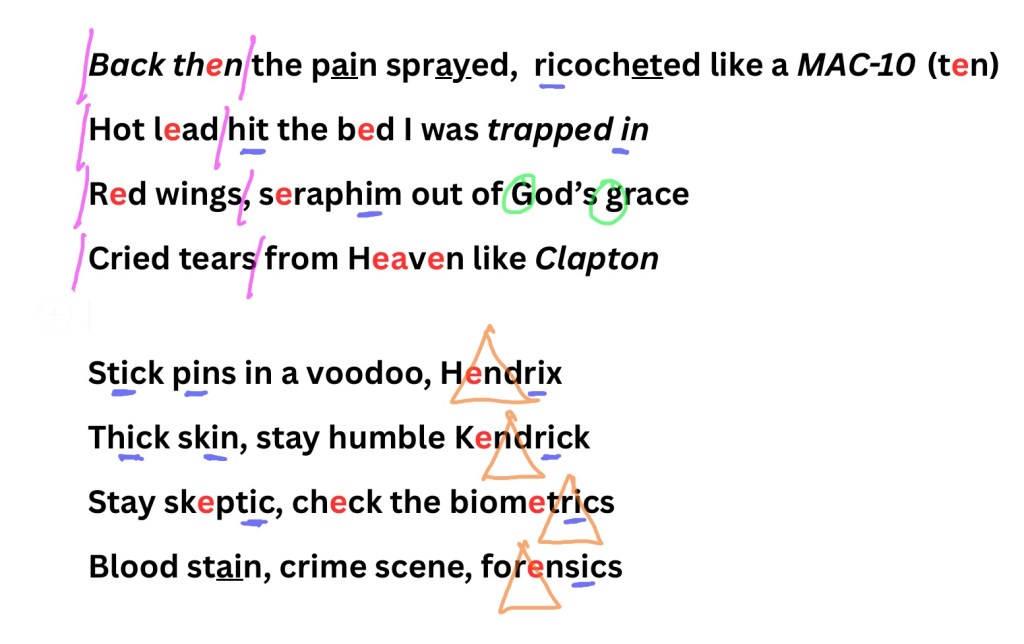
In the visual pasted below, you can see the overlapping wordplay expressed in this section. In the very first line there is a two-word internal/external with “back then” and “MAC-10.” These are also rhymed later with “trapped in” and “Clapton”. An almost incidental near rhyme comes from the ending of seraphim. While the beginnings of each line don’t rhyme, there is a syllabic rhythm stemming from two-syllable word pairs: back then/ hot lead/red wings/cried tears. This is followed in the following stanza by stick pins/thick skin/blood stain. The lone diversion from this rhythm is in the second to last line with “stay skeptic”. There’s always one renegade.
The second stanza contains pretty traditional end rhymes: Hendrix/ Kendrick/ biometrics/forensics, with the –ick sound prevalent. In the second to last line, skeptic also slides in to enrich the scheme.
There are several layers of vowel assonances in these stanzas. The first would be the e sound of then, ten, lead, bed, red, heaven, Hendrix, Kendrick, skeptic, check, biometrics, forensics. Other examples include /ai/ as in pain, sprayed, ricocheted, grace, stay, stain, and /i/: in, seraphim, stick, pins, Hendrix, thick, skin, Kendrick, biometrics, forensics.
Last, small alliterations appear in “God’s grace” and with letter n, which is repeated throughout. All of these aspects together create a complex and masterfully interwoven pair of stanzas.
In this section, according to Anthony Ray, Ren’s drill influence begins to really play into the rhythm.
[Bridge]
Lights on, lights out
Fade into the background
So down, so down
Runnin’ from the silhouette of self-doubt
In the bridge, Ren acknowledges light and dark again, and asks himself to step outside it for a moment. Similar to the struggle vs. the dance spoken of in “Hi, Ren”, the sufferer must occasionally step out of the fight and let the pendulum swing as it will. He must slow down and observe, quit running from his own darkness.
By now, by now
Really should’ve figured this shit out
Lights on, lights out
Smackdown
By continuing to struggle with physical pain and the accompanying psychological warfare, he’s prevented himself from finding balance in the dance (or, in his words, “figur[ing] this shit out.” Embroiled in the war between dark and light, between good and evil, he just gets beaten down.
The bridge returns once again to a simpler set of rhymes. Out, -ground, down, doubt, now, out (2x), -down. The repetition in the verse smoothly enhances the melody.
Verse 6
Bar 1
Let it be, let it be, quote John Lennon
Click-clack, John got shot for attention
What does that tell you about the good of intentions?
Bitterness formed in the storm of aggression
[Note: Ren has recognized that he made an error and that “Let it Be” is a song written and sung by Paul McCartney. To his defense, the Beatles broke up in 1974 and Lennon was murdered in 1980, ten years before Ren was born. It is also credited, as are most Beatles songs, to both McCartney and Lennon.]
“Let it Be.” The phrase is a call for acceptance and peace. For acknowledging things as and where they are in the moment. John Lennon (regardless of his state of current cancellation) was known in his later life as a proponent of peace and harmony. The fact that he was murdered by a person seeking ‘glory” (the murderer’s own words) is an ironic blow to that message. It seems that, as they say, no good deeds go unpunished. Even those who do good things in the world may receive unjust punishment. In fact, others’ goodness may even spark aggression (wrath) and bitterness (envy).
Ren has personalized the injustice towards the undeserving before, when he sang in “Everybody Drops”: “I swear that I had never done anything to deserve this/I kept my spirit kind and yet it’s burning in the furnace.”
Ren often repeats words or sounds in quick succession, which is reminiscent of percussion, and therefore apropos to rap. Here,
The phrase “let it be”, the onomatopoeic “clack”, and the name John, are each repeated. Otherwise, the end rhymes are the main poetic focus (Lennon/attention/intentions/aggression.) Formed and storm as an internal rhyme, lean on a shared /or/.
Bar 2
Prophets get dropped, imagining heaven
Martin Luther, Mahatma – dead and
Six, six, followed by six and seven
Build ’em, praise ’em, bury ’em, dead ’em
John Lennon might not have sung “Let it Be”, but he did sing “Imagine”, and although he was imagining “no heaven”, he seemed to be angling for its equal on earth, a place where humans find peace and love in the here and now. Still, in this context, a prophet for peace.
In the Bible, Jesus speaks about how a prophet is never given honor in his own land. (Mark 6:4) This has proven true over and over (depending, of course, on whether one considers certain humans to be “prophets.”) Certainly, people who have called for peace and justice have often been targeted for execution. Martin Luther (King, I’m assuming, not the original, as he died naturally) and Mahatma Gandhi were both murdered by their own countrymen for their political and moral stances.
“Six six, followed by six…” would refer to 666, the supposed “number of the Beast” (often seen as the Devil, the Antichrist, or just “evil”) referred to in chapter 13 of the Book of Revelations. Another name for this number is “the number of Man” indicating that Man is equivalent to a beast (i.e. inherently sinful.)
(…and seven)
The number 7 (“lucky number 7”), when considered Biblically (to counter 666), is the number of completion; hence, a godly number. Seven appears several times in Jewish and Christian symbology. Seven days, seven pairs of each clean animal led into the ark by Noah in Genesis, Seven years of plenty and seven years of famine in Pharaoh’s dream. The seventh son of Jacob’s name was “Gad”, which means “good luck”, seven pillars of the house of wisdom, seven seals of Solomon, seven sins and seven virtues, seven last sayings of Jesus on the cross, and many more…
Of course, there is another layer when you consider “followed by six and seven” as 6+7 which adds up to lucky 13. (Back to Revelations 13?)
And what do we do to our prophets and heroes? We build them up, put them on pedestals. When they get “too big” we tear them down, and sometimes we even kill (or cancel) them.
Poetically, the second half of the verse diverges a bit. There are still standard end rhymes (heaven/ deadened/ seven/ dead ‘em), but there are other devices used. In the first line, prophets and dropped share the short /o/ sound. The second line has an /m/ alliteration. Line three repeats six three times and adds seven for an /s/ alliteration: sublime sibilance.
Throughout both halves of the verse, the vowel assonance of the /eh/ is carried through the rhymes. Repetition plays a role with the three sixes (the number of man combining into the number of the beast,) and the syllabic symmetry of the whole last line: (build ‘em/ praise ‘em’/ bury ‘em/ dead’em.)
Verse 7
Bar 1
I was born to be half a man with half a chance
My heart is in half; half-righteous, half is damned
And half a gram, half those troubles and
Thoughts stay darker than Uruk-Hai’s master plan
Once again, despair and self-doubt take hold. Ren feels as if this dis-ease is not only his bad luck, but his fate. He was born for this. Born to be “half a man with half a chance”: never meant to be whole. His heart, broken, is bifurcated. Half righteous (representing the seven virtues perhaps?) and half damned, poisoned by sin.
This “half” could also be another comment on the dual nature of humans that Ren often refers to. Half dark, half light. Here, Ren feels as if he was born to the dark, even if half of his heart is still righteous. This is something he mentions in “Hi Ren,” his best-known song with that theme. In that song he says, “I was made to be tested and twisted/ I was made to be broken and beat.” It’s only later in the verse where he mentions that he is actually the light half of the eternal dance.
The pain of feeling incomplete bends toward the damned, and despair looks towards ceasing of the pain. “Half a gram,” perhaps, referring to drugs that can stop the heart, and thus the pain. Suicidal thoughts are some of the darkest and most cruelly persistent, compared here to Sauron’s evil plan of destruction attempted by the villainous Uruk-Hai in Lord of the Rings.
The word ‘half’ is repeated for emphasis seven times, a coincidence? the /a/ in half is carried throughout the verse (half/ man/ half/ chance/ half/ half/ half/ damned/ half/ gram/ master/ plan). The words heart and Hai from Uruk-Hai add to “half” for h-based alliteration, while “darkness” and the “Uruk-Hai” provide a quick /k/ percussion in the last line.
Bar 2
Sharper than glass shards, splinter and
Sinner man, sinner man, irony could kill a man
Pain makes money when the music lands, expand
Pay me my cheese, rain down parmesan
Ren talks about shards of glass, metaphorically splintering, perhaps cutting and wounding. Perhaps this is the broken glass with which he will write his eulogy?
“Sinnerman” is a song made famous by Nina Simone in 1956. In the song, the sinner attempts to run and hide from God’s judgement, but the rocks, the river, and the sea all refuse to hide him. Desperate, he begs for the Lord to hide him, but he is rejected, and told to go to the Devil because he should have been praying for forgiveness rather than running and hiding in fear.
Ren has already claimed the identity of the sinner man, even though he is the passive recipient of an illness he never deserved. Ironically, one who has been innocent will be destroyed by punishment; he who seeks the “Savior” will be damned to the Devil.
Ironically, Ren’s songs about his struggle are what has brought him acclaim. Therefore, if Ren is being punished by God, it is also ironic that he is now finding success. His pain is making him money (“raining down parmesan”) and bringing him acclaim.
This last stanza in verse 7 hangs on to the rhymes and triple syllabic pattern of “master plan” continuing with “Sinner man, kill a man, money when (a near rhyme), music lands, parmesan.” All this, and Ren throws in the word expand to extend the rhyme. Other word play includes the /sh/ in sharper and shards, and the near rhyme of splinter/sinner. Sinner man is repeated, seemingly for emphasis. Pain, makes, pay, and rain contain the /ai/ sound, and add a sense of fluidity to the last two lines.
Verse 8
(Six six) Six followed by seven
Seven whole sins for a self-made Armageddon
666, 7, 13…
The seven sins, of course, are choices we make to commit ourselves. When we choose, indulge in, and perpetuate sin, we participate in our own destruction.
Let me offer a brief exegesis on each of the sins below. Below the video is a link my further explication on the Seven Sins, where you can also see the video for the Money Game promotion Ren ran in advance of the album’s release.
Poetically, the introductory lines to verse eight return to the sibilance we found in previous verses. Six, seven, sins, self. Along with the repetition of six and seven, the hiss of so many esses brings to mind the snake in Eden.
Sin one: Pride
Pride makes a man kill a man for his ego to survive
Pride was considered by the theologians of the early church to be the most egregious sin of all, as it feeds into and is the basis of all other sins. It was pride, after all, which led Lucifer, the most beloved of God’s angels to rebel and rise up against his maker.
Lucifer’s pride had him believe he was more powerful, more knowledgeable than God himself, which then led him to seduce Eve, (and through her, Adam) to commit the original sin of disobeying God, and thus doom humankind.
Songs that examine pride on Sick Boi might be “Animal Flow” and “Down on the Beat.” Flexing, claiming the title of “king,” or otherwise claiming superiority over others is a characteristic of pride.
Humility, the countering virtue, is also found in Ren’s alternate characterizations of himself, as well as in his real-life nature.
Ren near-rhymes the first and last word in the line: pride and survive both contain the /i/ sound. There is also a rhythmic triplet with “makes a man” and “kill a man”.
Sin two: Lust
Lust makes the grass look greener, crucifies trust.
Lust, the insatiable, overwhelming desire for sexual gratification (or other forms of pleasure), leads to fornication, betrayal, adultery, and perversion. While all humans feel desire as part of our animal nature, when it gets out of control it falls into the realm of lust.
One can also have lust for material goods, especially ones that are very luxurious and therefore appeal to the senses, for example: furs, jewelry, couture clothing and accessories, etc.
In a positive light, people call enthusiasm and joy (benign emotional pleasure seeking) “lust for life.” As this does not exploit anyone, it has no negative connotation. Lust is harmful when connections to people are either commoditized or replaced by connections to inanimate objects (such as in the receipt of lavish gifts), reducing love to transactional behavior.
Lust appears on Sick Boi (pretty obviously) in both “Love Music pt. 4” and “Uninvited,” and it also makes an appearance in “Down on the Beat.”
Again, Ren rhymes the first and last words, lust and trust. This time he alliterates grass and greener.
Sin three: Gluttony
Humans consume and consume, planet Earth gets a frontal lobotomy
Gluttony is the obsessive consumption of food, drink, and other intoxicants, although it can occasionally refer to the overuse of resources. In the classic sense, gluttony refers to pretty much any occasion of taking pleasure in food and drink, although today it most often refers to excessive overeating and waste, especially when it leads to other humans suffering from deprivation and hunger.
Gluttony appears on the album mostly in the form of the rape of the earth for resources and the overconsumption that leads to global destruction. This gluttony walks hand in hand with greed, of course.
Ren mentions this eagerness to devour the earth in the song “Sick Boi”, and also refers to the overconsumption of alcohol and drugs in “Money Game 3.”
The word “gluttony” in this line is not repeated in the definition, but only in the first statement of the sin. It is near rhymes with the final word “lobotomy.” Meanwhile, the word consume is repeated to emphasize the action within. The /uh/ sound rides through gluttony, consume, and frontal.
Four: Sloth
Rinse and repeat, re-runs, repeat, time lost
Sloth has may possible meanings, but Ren leans into the wasting of time as his primary definition: the wasting of the intellect, and the wasting of opportunities for connection with the self, others, and the natural world.
It’s possible that some of this is frustration with not being able to do things due to his ailments, being forced to spend time doing literally nothing, and losing large swaths of his life while others choose to waste time because it’s their “God given right” to slack off (as mentioned in his video for “Sloth”, recorded as part of the “Money Game” promotion for Sick Boi.)
If sloth includes enforced downtime; time lost through illness or depression (sometimes considered sloth by non-empathetic theologians), then songs that embody it will begin with this one, and include “Suicide”, and “Lost All Faith”.
Sloth and lost parenthesize the alliterate words rinse, repeat, reruns repeat, which are on their own repetitive. The way Ren places such meaning into poetic devices shows true skill, whether or not it is deliberate.
Sin five: Envy
That’s when one man’s win is another man’s frenzy
Envy takes hold of the soul when the desire to have what another person has, whether objects, traits, achievements, or relationships, becomes so overwhelming that a person wishes harm or bad fortune on the one with the more successful life.
Envy is connected closely with greed, of course, where others’ wealth and status drive the envious person to seek and obtain more and more. Envy gets in the way of relationships with others in society and causes bitterness, such as that of Jimmy’s father in “Money Game 3.”
Each line here is using the same rhythm of internal/ external with the first and last word matching; here it is envy/frenzy. the center of the line takes on some extra rhythmic pattern to fill in the gap. In this line, “one man” followed by “another man”. “One” and “another” don’t rhyme per se, but the assonance of the n contributes to the flow of the line.
Sin six: Wrath
Rage, vengeance, killers, psychopaths
Wrath is anger gone berserk. Unlike righteous anger, which is directed directly at injustice, wrath is directed at an innocent person or blown out of proportion as the wrathful one focuses on vengeance for slights real or imagined.
Wrath can range from road rage, to murder, to genocide. We’ve seen wrath in earlier songs, such as “the Tales”, and on Sick Boi a murderous character emerges in several tracks. “Animal Flow”, “Murderer”, and “Illest of Our Time”, are prime examples.
Wrath is countered by patience, which Ren seeks to cultivate in himself in songs like “Lost All Faith.”
Wrath is rhymed with psychopath, of course, and the other words are punches created with an enraged voice, intensifying the delivery.
Sin seven: Greed
Greed plants a seed that will destroy us all if we succumb to greed
Greed is, and has always been, a topic weighing heavily on Ren’s mind. He has spoken directly about money, gold, and/or greed in no less than twenty of the songs in his catalogue. Recognition and reduction of corruption and greed is one of his most deeply held personal ideals, wishing instead for people to focus on collaboration and empathy to decrease humanity’s suffering.
Ren has often pointed out, especially in the Money Game trilogy, that humans are inherently susceptible to greed, and that in modern society, we are all cogs in a machine built, maintained, and driven by greed.
This line is actually lifted from an earlier song, “Crucify Your Culture”, which focuses solely on greed as a social poison. The word “greed” itself is emphasized by its repetition (a total of three times) the long /e/ sound (ee), then carries through the line: greed, seed, de-(stroy) we, greed. This repetitive pattern continues in the next stanza.
If we take what we need, then take more than we need, then our oceans will bleed
Still, we feed and we feed and we sleep and repeat
Then we exile the shepherds and follow the sheep
We inherit the meek
Greed, he warns us, is depleting the world of resources and drowning us in waste and destruction. Humans are slaves to greed, going as far as to punish those who attempt to disrupt it (see the verses above about where good intentions lead.)
Ren likens the humans who buy into the status quo as “sheep”, who refuse to think for themselves and advocate for change, for a more egalitarian, even utopian, society. In Ren’s world “sheep” are not those who choose one political ideology over another, but those who are stuck in any ideology that allows other humans to suffer.
In this world, instead of the meek inheriting the earth, those who grab and steal resources “inherit” or absorb, the innocents whose inheritance the earth was meant to be.
We may be hypocrites, all of us, but by rejecting the lure of money and fame (never chasing numbers, statistics, or stats) we can begin to build a society in which egalitarianism wins out over greed.
If we take what we need, then take more than we need, then our oceans will bleed
Still, we feed and we feed and we sleep and repeat
Then we exile the shepherds and follow the sheep
We inherit the meek
Highlighted in red are all of the words that carry the /ee/ assonance from the previous stanza. Once again, there is the repetition of words (need, feed) for emphasis. Both are internal rhymes that match the four near rhymes at the end: bleed/ repeat/ sheep/ meek.
We inherit this world that we bruised and we beat
We inherit this vanity, circles of greed
Inherit the liars, the murderous thieves
One sin for every one day of the week
We live in a sin-filled world. One we inherited, and one we continue to perpetuate. Sins seem to be ingrained, not only in our society but in our own framework, our internal wiring. If we are sinful and are the victims of others’ sins, we have earned it, for we refuse to think in a way that will break down the harmful attitudes we instinctively and mindlessly embrace.
“One sin for every day of the week” expresses the idea that our bad habits and behaviors are pervasive and ever-present. It won’t be easy to change. It seems that Ren is pointing out that sins seem to come more naturally than virtues, and it will take concerted effort to make reasonable changes, much less to build the utopia we could create if only forward-thinking minds would come together in collaboration.
Ren offers up a tight ending. Beginning each of the first three lines with a repetition of “inherit”, he ends each with a syllabic quadruple. The final line, “one sin for every day of the week” is a final punch: a strong statement that foreshadows spiritual sickness as one of the album’s major themes.
Final Thoughts:
“Seven Sins” is one of Ren’s most powerful songs to date. It’s a fitting introduction to the Sick Boi album, illustrating all of the struggles Ren faced over the last thirteen years to get to this point: where he can finally tell his story in full and find an ocean of willing listeners. Unlike his first album, Freckled Angels, which was mostly optimistic (many of the songs written before his illness) and embraced by a smaller number of (still fervent) fans, Sick Boi abandons hope and embraces trials.
“Seven Sins” is Ren‘s eulogy, but it is deep and complex. As the final song completed for the album, it is written from the perspective of one who has suffered, yes, but has come out of his agony enough to provide some perspective. In many ways, he is saying goodbye to the Sick Boi, and making room for a new, older, and wiser Ren to emerge.
Until next time,
Oi, Renegades!
c. 2023 D.B. Myrrha
Self-Made Armageddon: A Brief Explication on the Seven Deadly Sins
More RENalyses: The Complete List


Leave a Reply